
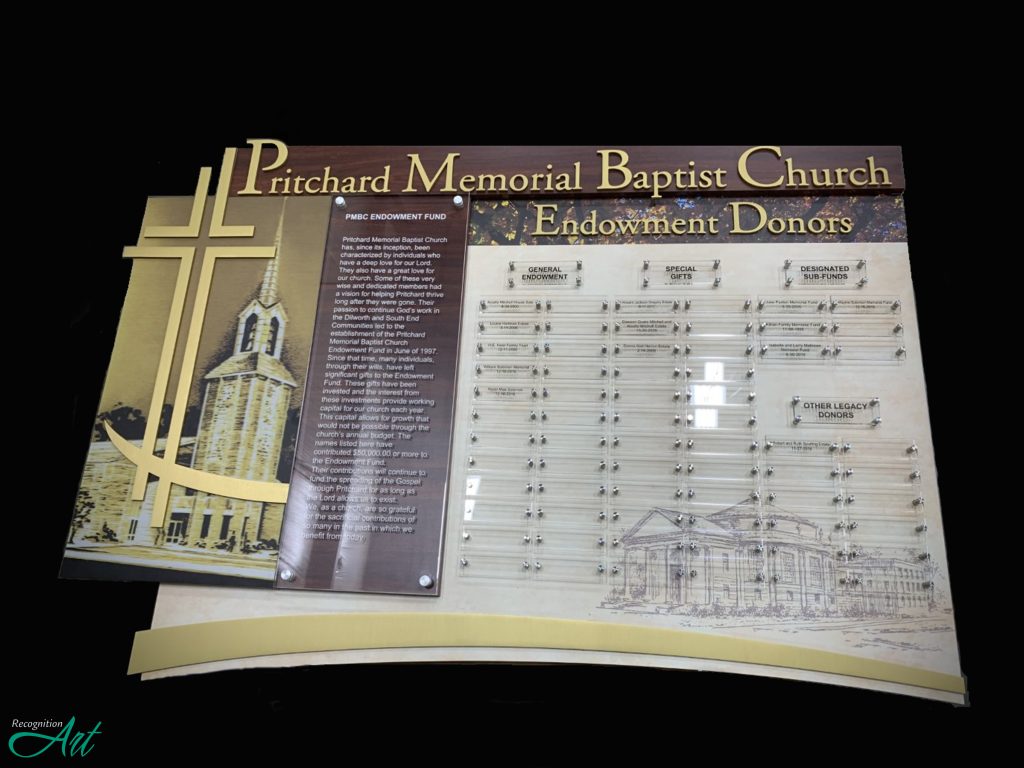
Faith-based donor recognition is the thoughtful acknowledgment of people and groups whose generosity supports a religious organization’s mission, ministries, facilities, and community programs. When it is planned carefully, recognition can provide a visible expression of gratitude while reinforcing the values that guide the organization.
Physical recognition should remain one part of a broader stewardship program. A church donor wall or plaque cannot replace personal thanks, responsible gift administration, impact communication, or respectful donor relationships. It can, however, create an enduring place where generosity and collective service are acknowledged.
At RecognitionArt, we create custom donor recognition walls, individual recognition plaques, glass and acrylic recognition displays, Corian® donor walls, changeable display systems, and other recognition formats shown throughout our product galleries. We collaborate with organizations to develop displays that reflect their identity, surroundings, and recognition needs.
What Is Faith-Based Donor Recognition?
Faith-based donor recognition is a stewardship practice used by religious organizations to acknowledge contributions without losing sight of humility, community, and mission.
Recognition may be connected to:
- A capital campaign
- A new building or renovated space
- Educational or scholarship programs
- Community outreach initiatives
- Ministry expansion
- A long-term giving campaign
- Support from founding or legacy contributors
The purpose should be clear before a display is designed. One congregation may want to document the collective effort behind a major facility project. Another may need an ongoing system for recognizing supporters of several programs. A third may prefer understated plaques for specific rooms or gathering spaces.
These situations call for different recognition strategies. The best format is not necessarily the largest or most elaborate. It is the one that fits the organization’s values, physical environment, donor policies, and long-term plans.
Why Faith-Based Recognition Requires Thoughtful Planning
Religious communities often approach public recognition with particular sensitivity. Leaders may want to thank contributors while avoiding an atmosphere that appears competitive, transactional, or focused only on financial capacity.
A well-planned recognition program addresses this tension by defining what the display is meant to communicate. The central message might be shared service, gratitude, community commitment, or the completion of a mission-centered project. Donor names and giving categories can then support that message rather than becoming the entire story.
The Association of Fundraising Professionals’ Donor Bill of Rights emphasizes that donors should receive appropriate acknowledgment and recognition while also having their privacy respected. The National Council of Nonprofits similarly identifies donor intent, public trust, and ethical fundraising conduct as important organizational responsibilities.
Respect Different Recognition Preferences
Not every supporter wants public attention. Some may welcome having their names displayed, while others may prefer household recognition, a collective category, or complete anonymity.
Before publishing a name, an organization should have a documented process for confirming:
- Whether the donor has agreed to public recognition
- The exact spelling and preferred presentation of the name
- Whether a household, family, business, or foundation name should appear
- Whether the donor wishes to remain anonymous
- Which gift or campaign qualifies for recognition
- Who has authority to approve the final list
These decisions belong to the organization and should be governed by its own fundraising, privacy, and gift-acceptance policies.
Avoid Using Recognition as Pressure
Recognition should communicate gratitude, not create pressure to give. A display can demonstrate that a community worked together toward a shared purpose, but it should not imply that public acknowledgment is more valuable than private generosity.
This distinction is especially important in faith-based fundraising, where donors may be motivated by personal convictions, service, tradition, or a connection to the community. The display should respect those motivations instead of reducing every contribution to a rank or dollar amount.
Connect the Display to the Campaign’s Purpose
A meaningful church donor wall should explain what generosity helped make possible. Without that context, visitors may see only a collection of names.
Consider including a concise mission statement, campaign message, project title, relevant imagery, or a brief expression of gratitude. The wording should connect donor support to the organization’s work without overstating specific outcomes.
For example, a display connected to a facility campaign might focus on creating a place for worship, learning, fellowship, or community service. A display associated with an educational initiative might recognize the people who helped expand access to faith formation or youth programs.
The final message should sound like the organization itself. RecognitionArt’s custom-design approach emphasizes the organization’s identity rather than treating every donor wall as the same project.
Choose a Recognition Format That Fits the Program
Different recognition formats serve different purposes. Organizations should consider how many people will be recognized, how frequently the information may change, where the display will appear, and how much supporting content must be included.
Donor Recognition Walls
A donor recognition wall is generally a larger installed display that acknowledges multiple contributors in one coordinated presentation. It may be appropriate for a capital campaign, facility project, or broad community initiative.
RecognitionArt’s gallery demonstrates custom donor walls using a range of visual approaches and materials. The company’s website includes Corian®, glass and acrylic, metal and wood, fundraising tiles, plaques, and other display categories.
Individual Recognition Plaques
An individual donor recognition plaque may be more appropriate when the organization wants to identify a specific room, area, program, donor, or giving opportunity. RecognitionArt presents plaques for individual rooms, locations, buildings, outdoor areas, activities, and other designated spaces.
Plaques can also complement a larger donor wall. The primary wall may explain the campaign and recognize the broader community, while individual plaques identify particular spaces or contributors.
Changeable Recognition Displays
A changeable system may suit an ongoing recognition program in which names, photographs, campaign information, or organizational messages are expected to evolve. RecognitionArt offers changeable donor recognition displays designed for future content updates.
Organizations should decide how frequently they expect changes before selecting a display structure. A permanent campaign roster and an annually updated giving program have very different operational needs.
Design for the Faith Community and Its Space
A recognition display should look as though it belongs in the environment. That does not mean it must reproduce every architectural feature or religious symbol. It means the scale, visual tone, wording, and placement should support the surrounding space.
Planning questions may include:
- Will the display be located near an entrance, gathering area, hallway, sanctuary-adjacent space, school, or community center?
- Will visitors have enough room to stop and read it?
- Should the presentation feel traditional, contemporary, understated, or highly visual?
- Is the donor list permanent, periodically updated, or part of a growing program?
- How will giving categories be explained?
- Will mission language or campaign history accompany the names?
- How will the organization account for accessibility and readable presentation?
RecognitionArt offers glass and acrylic displays, Corian® donor walls, metal and wood examples, plaques, changeable systems, and freestanding displays. Each option should be evaluated according to the specific project rather than assuming one material or format fits every faith-based setting.
Establish Fair and Consistent Giving-Level Rules
Giving levels can help organize a large donor list, but the rules need to be determined before names are submitted for production.
The organization should document:
- Which gifts count toward the display
- Whether recognition is based on a single campaign or cumulative giving
- How pledges and completed gifts are treated
- Whether households and organizations are grouped differently
- How anonymous gifts are represented
- How exceptions are approved
- Whether future donors can be added
Level names should fit the organization’s culture. Generic metallic categories or competitive-sounding labels may not feel appropriate for every faith community. Mission-related or campaign-related terminology may be more suitable, provided the categories remain clear and consistently applied.
RecognitionArt does not determine an organization’s fundraising policies or giving thresholds. Those decisions should come from the organization’s leadership, development team, and approved campaign documents.
Create a Reliable Name-Approval Process
A beautiful display can still create frustration if a name is misspelled or presented incorrectly. Name verification therefore deserves its own review process.
A practical workflow includes:
- Exporting the donor list from the organization’s approved records.
- Confirming qualification under the recognition policy.
- Asking donors to verify their preferred listing.
- Reviewing spelling, punctuation, titles, and household names.
- Checking anonymous and confidential records separately.
- Obtaining internal approval from the designated authority.
- Conducting a final proof review before production.
More than one person should review the final list. Development staff may understand donor preferences, while campaign leaders or finance staff may need to verify eligibility.
Common Faith-Based Recognition Mistakes
One common mistake is beginning the design before the recognition policy is final. This can lead to changing categories, missing names, inconsistent treatment, and repeated internal reviews.
Other avoidable problems include:
- Treating every donor as though they want public recognition
- Allowing different committees to use different naming rules
- Making the donor list more prominent than the campaign’s purpose
- Choosing a permanent format for information that changes regularly
- Failing to plan for future names or campaigns
- Using language that feels transactional or competitive
- Waiting until the campaign ends to begin recognition planning
- Skipping the donor name-confirmation process
Early planning gives fundraising, leadership, communications, and facilities teams an opportunity to resolve these issues before production.
Frequently Asked Questions
Should every faith-based donor be named publicly?
No. Donors may have different preferences, including anonymous recognition. Organizations should confirm consent, follow their privacy policies, and respect the donor’s requested form of acknowledgment. AFP resources emphasize the importance of donor privacy and ethical handling of recognition.
Where should a church donor wall be placed?
The appropriate location depends on the building, visitor flow, purpose of the campaign, and desired level of visibility. A lobby, gathering space, hallway, educational facility, or community area may be considered, but the display should not obstruct movement or conflict with how the space is used.
Must a faith-based recognition display include giving levels?
No. Giving levels can organize a large list, but they are not required. Some organizations may prefer alphabetical recognition, campaign groups, founding supporters, community partners, or another structure consistent with their approved policies.
Is a donor recognition wall the same as a memorial display?
Not necessarily. Donor recognition acknowledges charitable support, while a memorial display usually honors someone who has died. A display can involve both ideas in certain circumstances, but the purpose and wording should make the distinction clear.
Can a recognition display accommodate future campaigns?
Potentially. RecognitionArt offers changeable and rotating display systems that may be considered when content is expected to evolve. The appropriate structure depends on the project, so future update needs should be discussed during planning.
Create a Meaningful Faith-Based Donor Recognition Display
Faith-based donor recognition works best when gratitude, mission, donor preferences, and organizational values guide the project. The display should acknowledge generosity without replacing personal stewardship or placing pressure on the community.
RecognitionArt can help your organization explore a custom donor recognition wall, plaque, acrylic or glass display, Corian® donor wall, or changeable recognition system based on the products and options shown on our website. Contact us to begin discussing a faith-based donor recognition display that complements your mission and space.